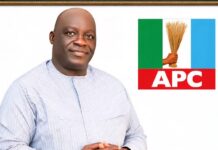

By Victor Nwokocha
It is no longer news that the APC 2027 Senatorial Candidate for Abia South, Hon. Erondu Uchenna Erondu Jnr, would on Tuesday, June 16, 2026 distribute 2000 50kg bags of fertilizer to farmers across the 6 LGAs and 65 Wards of Abia South Senatorial District.
Remarkably, this is only a fraction of his longstanding, people-centred empowerment agenda which has been of immense benefit to youths, women, entrepreneurs, students and elderly persons within and outside his constituency. His name has long been synonymous with service beyond borders.
But why does his fertilizer distribution scheme deserve special attention? The answer is found in the significance of agricultural revolution, not just in Abia South or Abia State but in Igbo land generally.
Historically, agriculture has been the backbone of Igbo society – originally undertaken at the level of subsistence farming. Given the demands of a growing population, climate change and economic pressure, an agricultural revolution in Igbo land is no longer optional – it is imperative.
This is where Hon. Erondu Jnr’s fertilizer distribution scheme helps to fill a yawning gap and raises awareness regarding a vital public need.
Igbo land has obviously faced declining soil fertility for decades now, necessitating the application of different variants of fertilizers to boost agricultural produce. Farmers and rural dwellers have often found it quite challenging to cope with rising costs of fertilizers which negatively affects harvests, coupled with issues such as land fragmentation and youth disinterest in farming, Again, considering that we are currently in the farming season, Erondu Jnr’s intervention is timely, supportive, compassionate and more humanitarian than political.
It would engender food security, boost local production of staples like yam, cassava, maize, and vegetables, stabilizing supply and cutting dependence on imports.
In terms of economic development, Hon. Erondu Jnr is evidently conscious of the fact that agriculture is capable of driving wealth creation beyond the farm. He is aware that agriculture creates thousands of jobs, and where there is reliable storage and good market access, people engaged in agribusiness would contribute to stimulating local economies, reducing rural-urban migration and sustaining alternative income sources beyond oil.
In the context of social development, Hon. Erondu Jnr understands that a thriving agricultural sector could revive communal labour structures and help to strengthen rural infrastructure especially roads. He is also aware that it guarantees improved nutrition with direct impact on community health. Notably too, he knows that a thriving agricultural sector would restore dignity to farming, making it attractive to the younger generation and empowering women who play vital roles in the food production and processing value chain in Igbo communities.
Thus, viewed from the prism of the imperatives of agricultural revolution in Igbo land, and the broader agenda of Igbo Renaissance, Hon. Erondu Jnr’s intervention underscores the need for agricultural education, massive investment in mechanized agriculture, support for cooperative farming, rural infrastructure and security.
He is reawakening our consciousness by reminding us that an agricultural revolution would not just feed Abia South, Abia State and Igbo land – it would ultimately strengthen the economy and social fabrics of Igbo land from the basics to the highest levels. Such a revolution must, essentially, transform subsistence farming to large scale, value-driven and technology-enabled agro-entrepreneurship.
Given his pedigree of consistency with sustainable empowerment and community development programs, the foregoing leaves no one in doubt regarding Hon. Erondu Jnr’s commitment to institute innovative schemes to boost the agricultural sector when he has the mandate of the good people of Abia South to represent them at the Senate.